Pardon Façade documents the artistic output of Luca Monterastelli, showcasing almost all of the sculptures and installations that he produced between 2011 and 2022. Across four chapters—corresponding to four solo shows that he staged in Milan, Otegem, Antwerp, and Naples—the publication provides the first overview of the artist’s work.
More than half a century after its premiere, Yvonne Rainer, in collaboration with choreographer and dancer Emily Coates, directed the 2019 revival of her 1965 performance Parts of Some Sextets. This book poses questions about the trajectories of artworks, performers, and audiences, all while tracing the life—and afterlife—of a dance.
How does technology organize life? This book documents and reflects on the exhibition Proof of Stake: Technological Claims at Kunstverein in Hamburg, curated by Simon Denny and Bettina Steinbrügge. It brings together a unique group of artists and scholars who investigate the technological apparatuses and power relations of organized life.
This artist’s first monograph brings together sketches, documentation and installation shots, as well as an in-depth analysis of her practice. It highlights her process of making art, from the conception of an idea to the finished work, and from the deconstruction and re-assembling of her characters’ identities to the relentless creation of new worlds.
Published on the occasion of the first exhibition in Italy by Jenna Gribbon, staged at the Collezione Maramotti, Mirages showcases a wealth of images that highlight the fluid, sensual output of this artist who, in repeatedly portraying her wife, the musician Mackenzie Scott (aka TORRES), explores the implications inherent in seeing and being seen.
The catalogue of this ambitious project, held at the Centre d’Art Contemporain Genève in 2017, reflects on the centrality of writing in contemporary visual art practices. Documenting its slippages from printed matters to the digital realm, from voice modulations to its sculptural presence, this book celebrates the word in all its forms.
Conceived by Philip Pilekjær, Samuel Haitz, Paolo Baggi and Tobias Kaspar.
Design by Pascal Storz and Lucas Manser
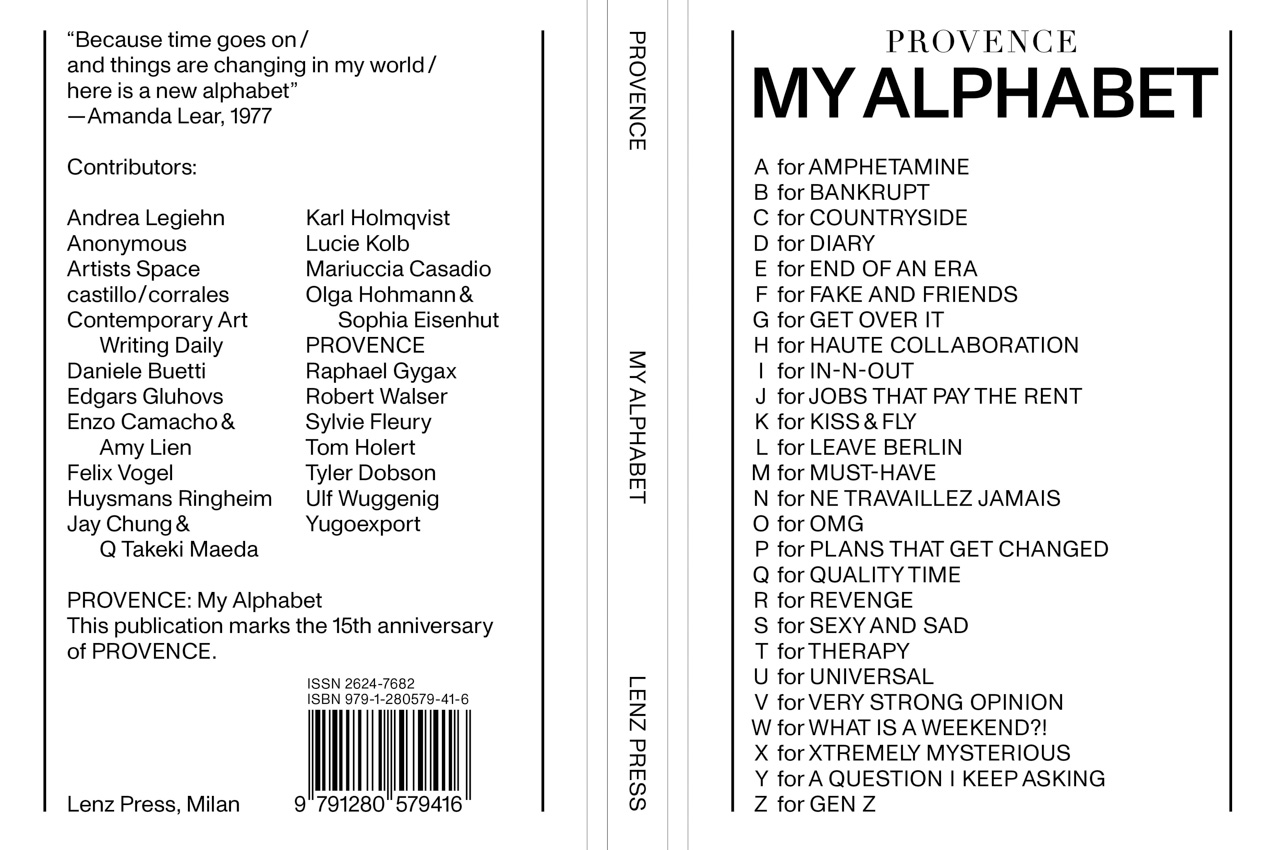
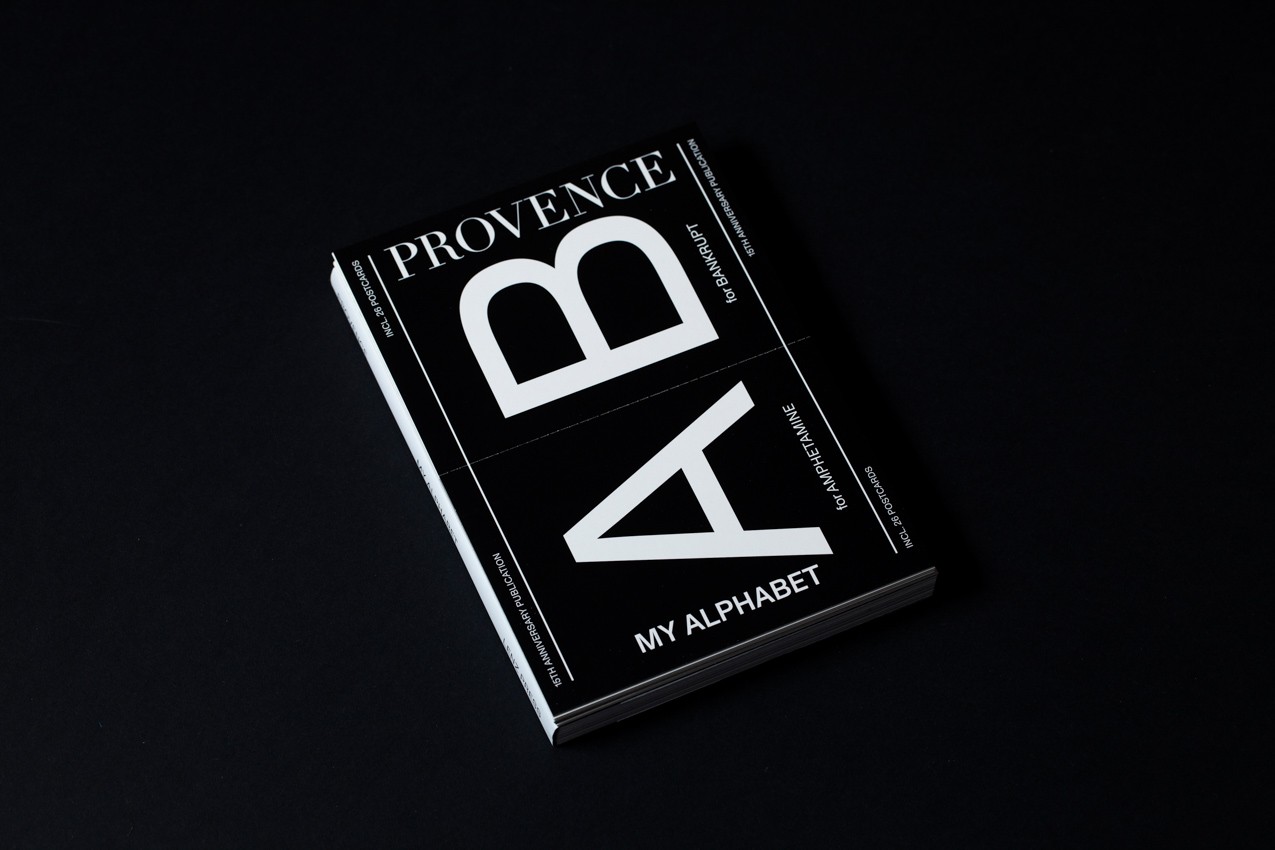
2024, English, softcover, 15 x 20.5 cm, 200 pages
ISBN: 979-12-80579-41-6
PROVENCE was founded in 2009 in Nice, France, and has since shape-shifted through a variety of constellations. Today, PROVENCE operates as a collectively run publishing house and agency for contemporary art.
The ambition of PROVENCE has always been to question and challenge its own format by conceiving exhibitions, artworks, and merchandise in parallel with its publishing and agency activities. This includes exhibitions at Halle für Kunst, Lüneburg; Artists Space, New York; an off-site Hannah Villiger exhibition in Basel; and participation in numerous group exhibitions. Also worth mentioning are a hair salon (never realized), numerous art fair booths, a collection of driftwood, a temporary casino hosted by Etablissement d’en face in Brussels, 215 very real press passes, media partnerships, a travel guide for Nice rated no. 1 in Vogue US, stickers, handbags, and plenty of dinners.
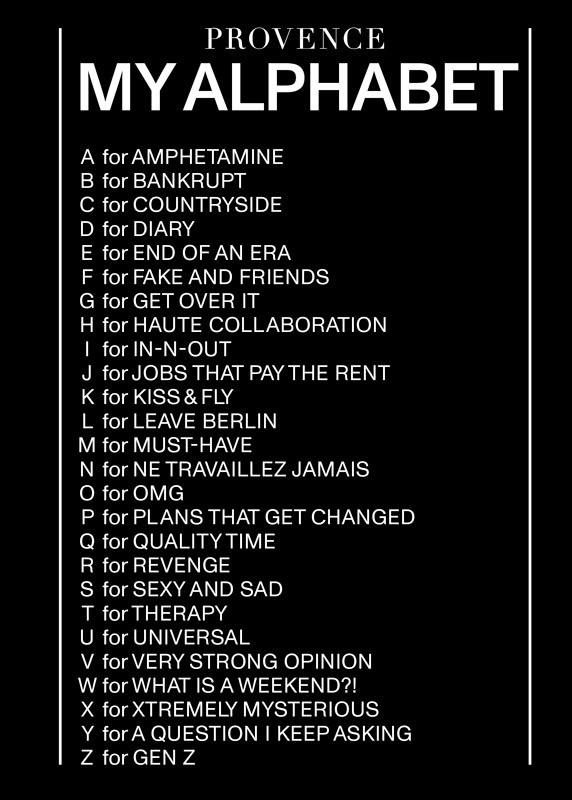
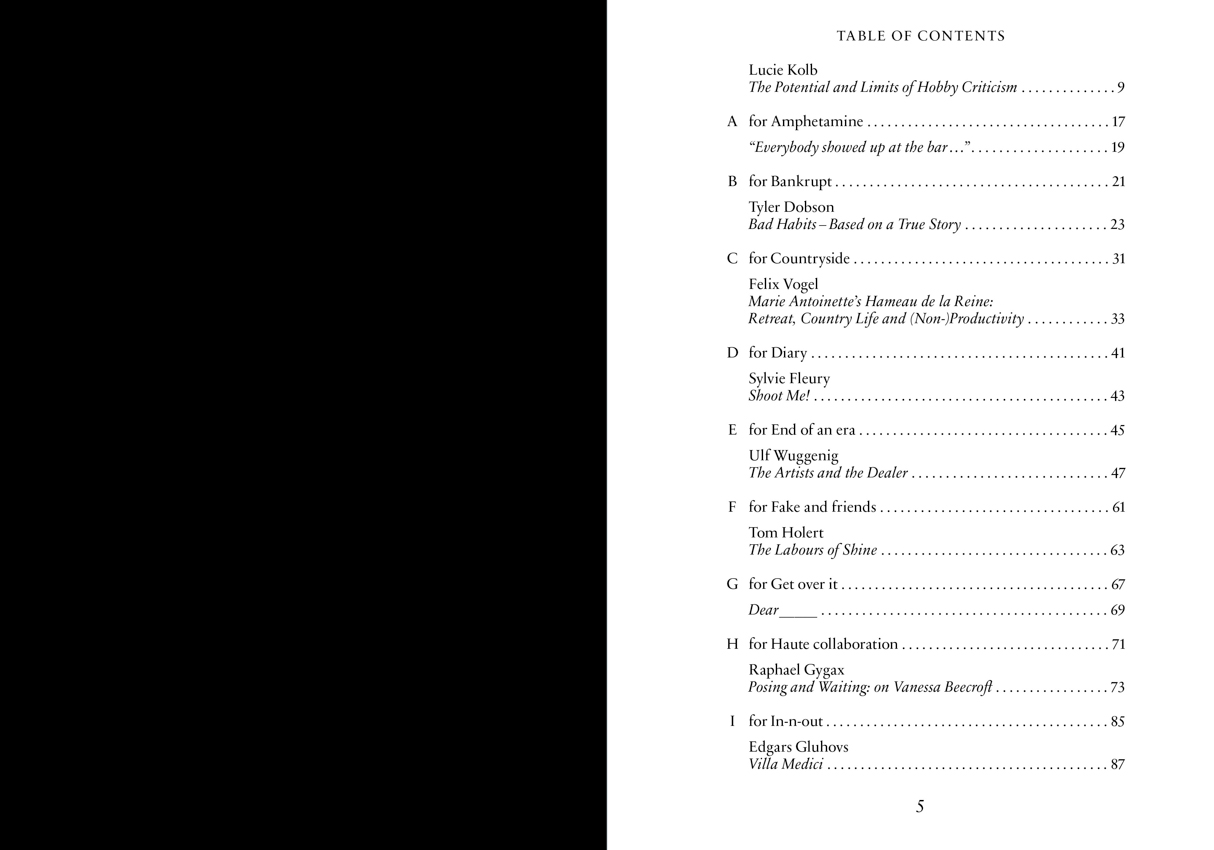
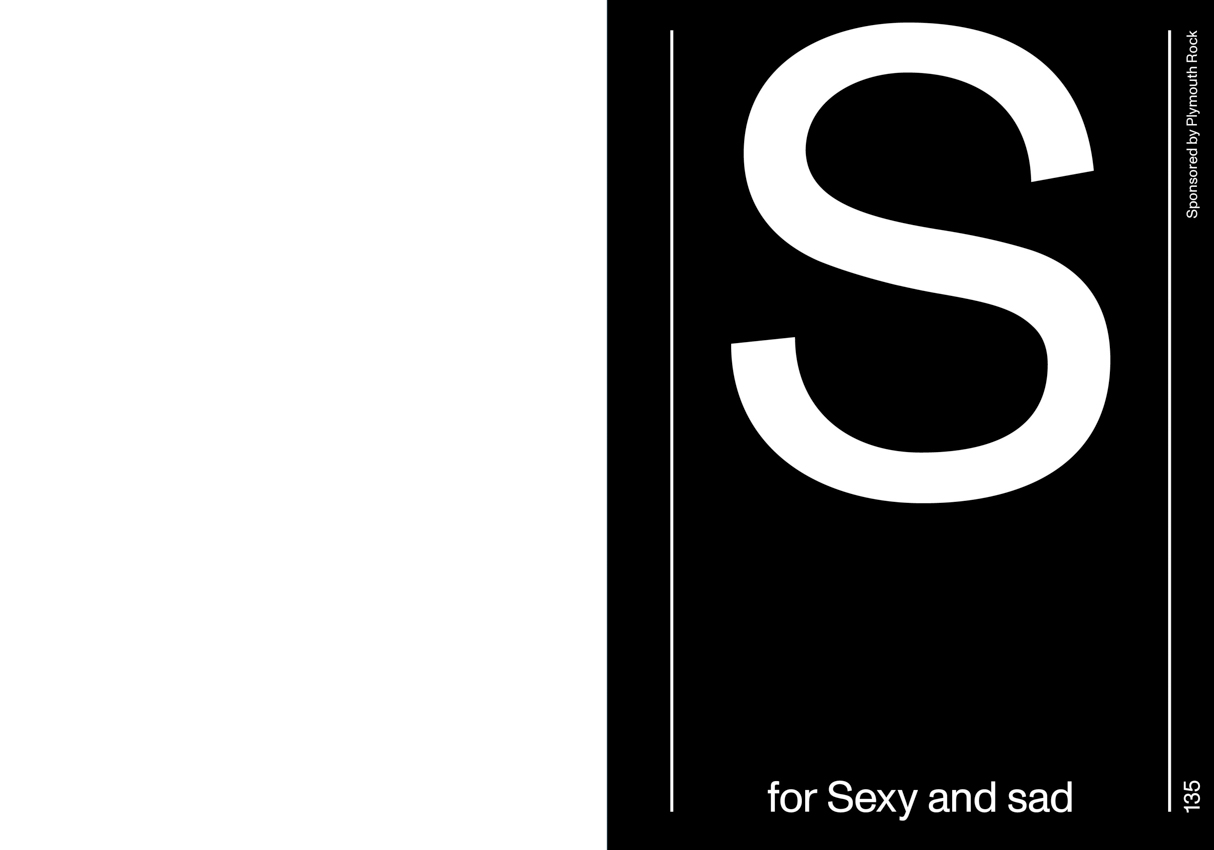
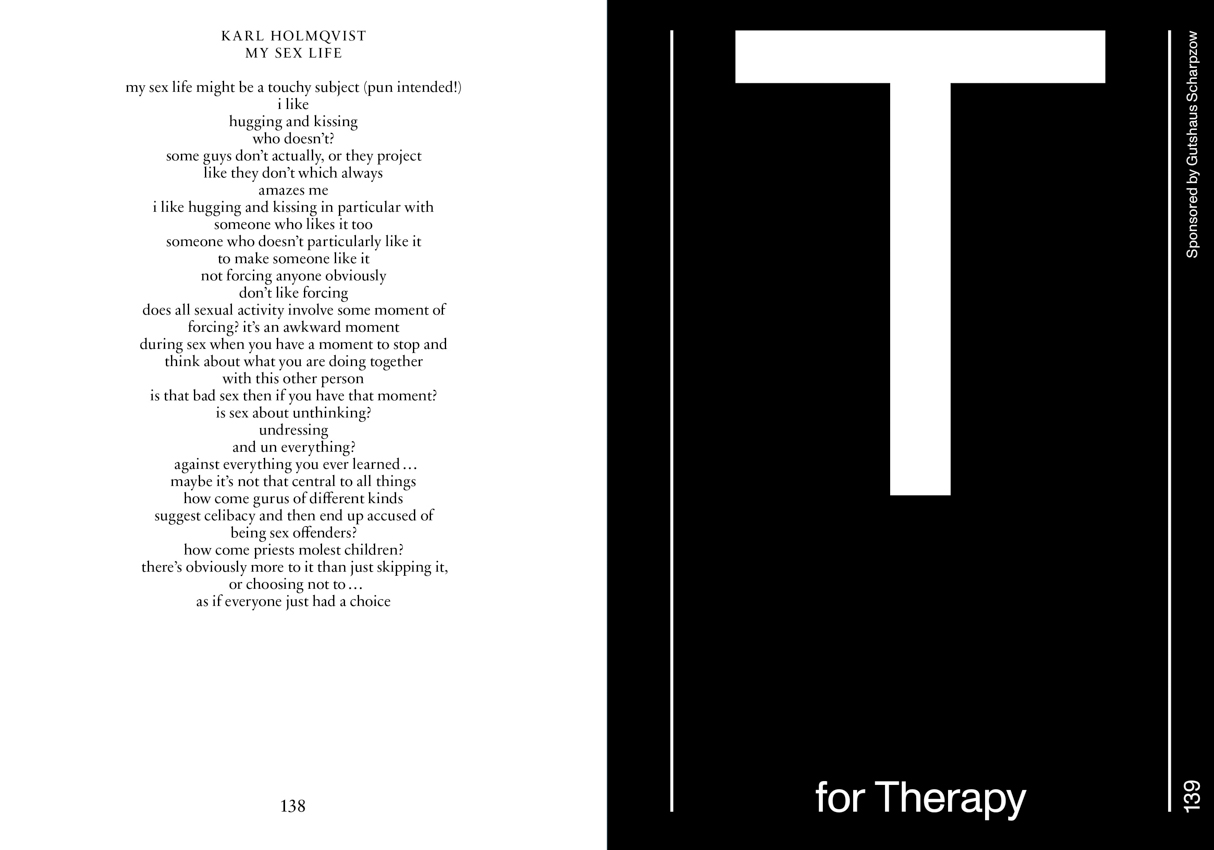
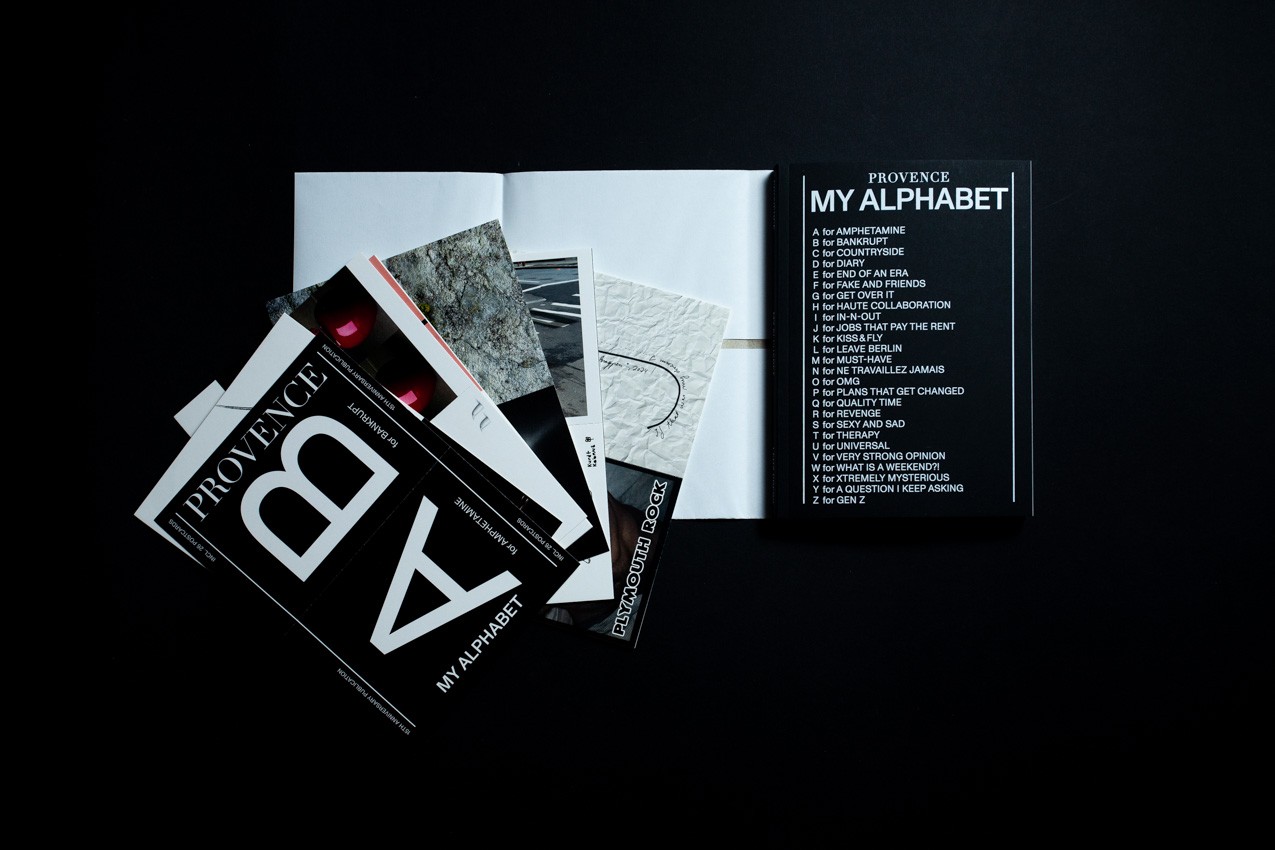
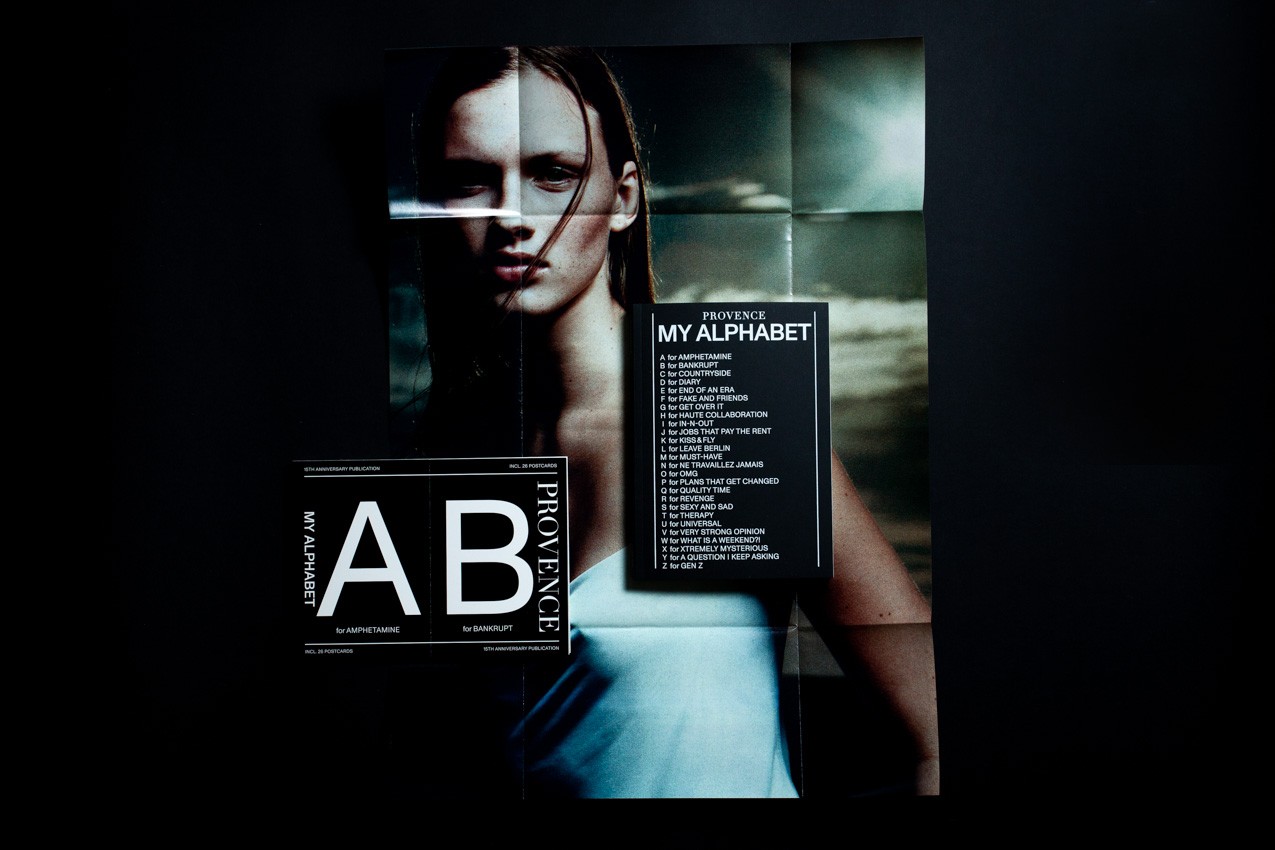
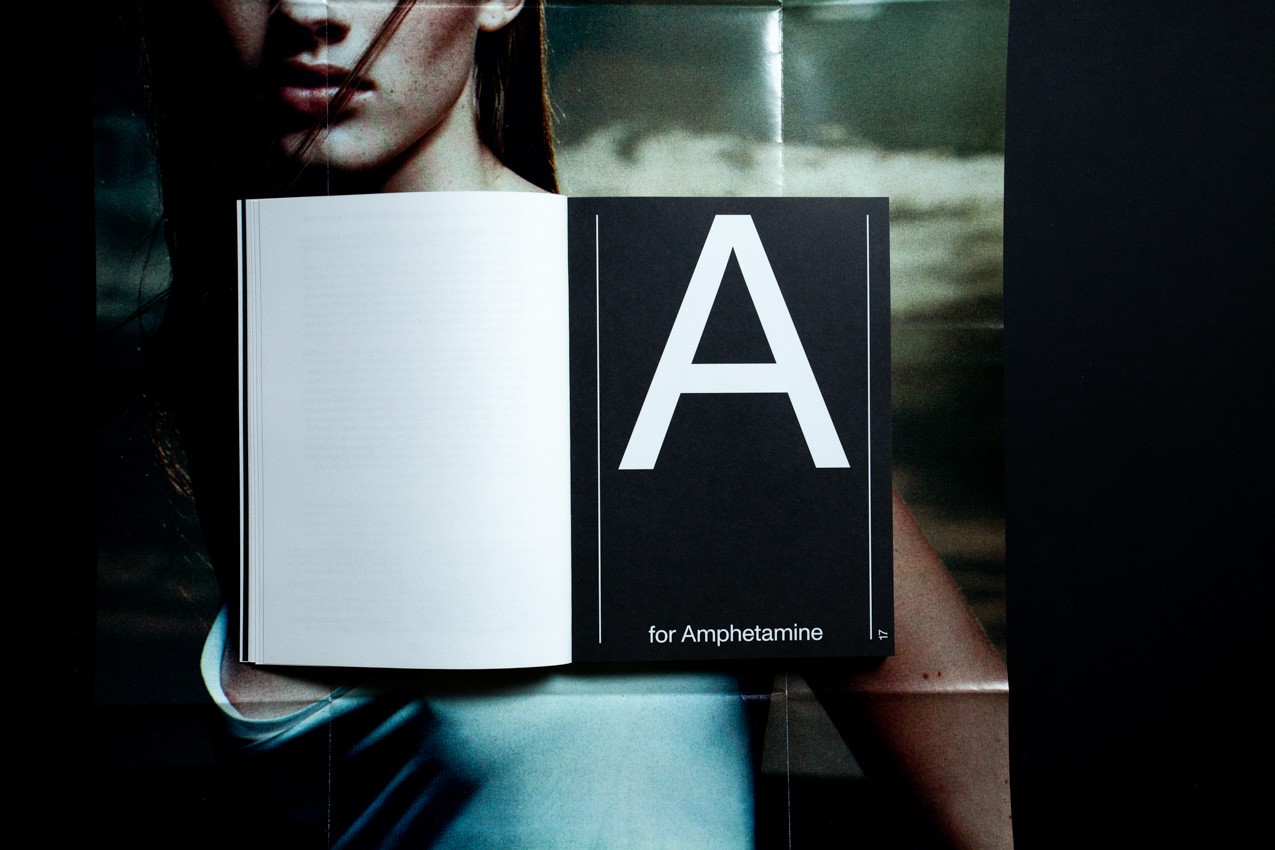
On the occasion of PROVENCE’s 15th anniversary, the reader My Alphabet presents 26 texts published by PROVENCE between 2009 and 2024, either in print or digitally in the weekly newsletter. These texts are sorted alphabetically, ranging from A for Amphetamine to N for Ne travaillez jamais to Z for Gen Z.
My Alphabet compiles selected contributions from the PROVENCE archive by Andrea Legiehn, Anonymous, Artists Space, castillo / corrales, Contemporary Art Writing Daily, Edgars Gluhovs, Enzo Camacho & Amy Lien, Felix Vogel, Huysmans Ringheim, Jay Chung & Q Takeki Maeda, Karl Holmqvist, Mariuccia Casadio, Olga Hohmann & Sophia Eisenhut, PROVENCE, Raphael Gygax, Robert Walser, Sylvie Fleury, Tom Holert, Tyler Dobson, Ulf Wuggenig, and Yugoexport. The book also features Lucie Kolb’s essay “The Potential and Limits of Hobby Criticism,” which illuminates the history and conceptual intentions of PROVENCE and was commissioned specifically for this publication.
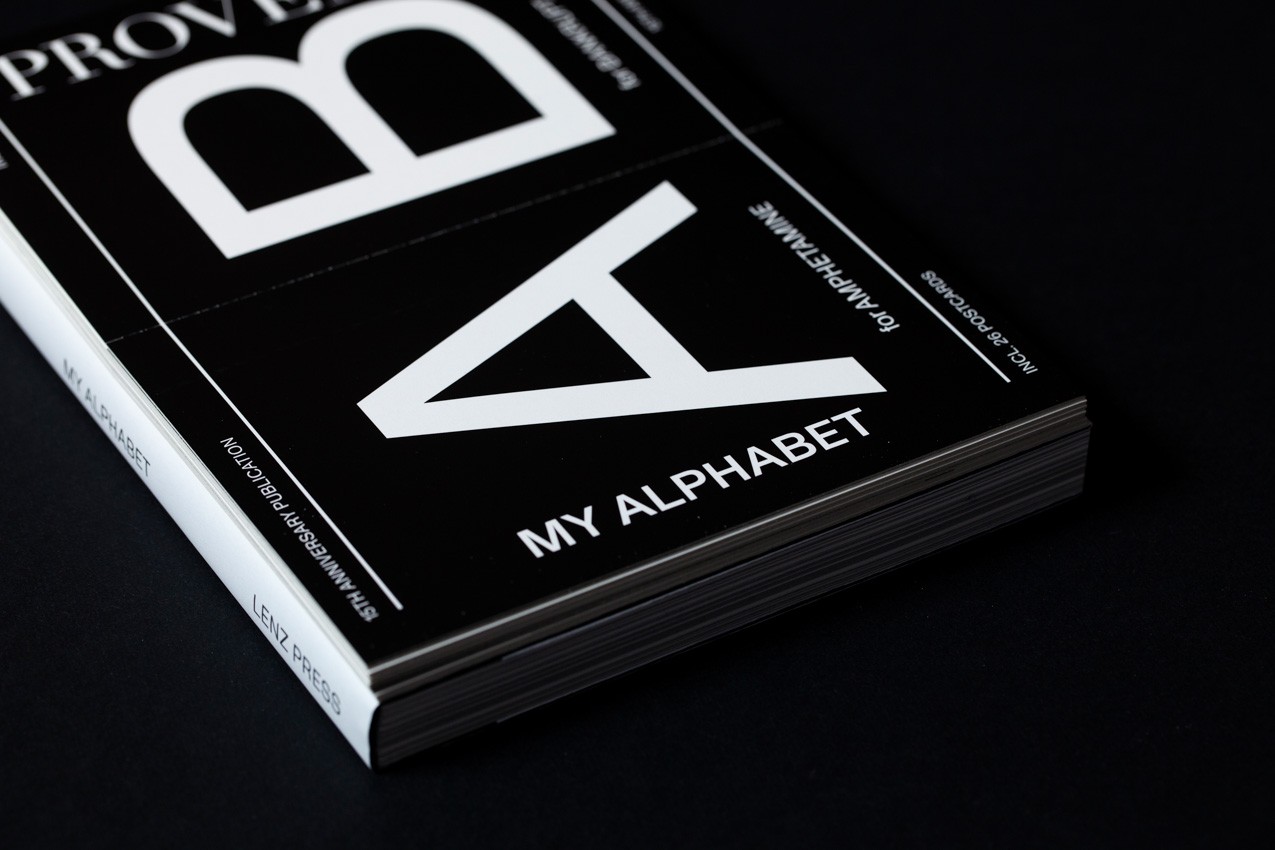
Additionally, My Alphabet is accompanied by a poster by Daniele Buetti hidden in the dust jacket and 26 postcards, each sporting a letter sponsored by institutions, galleries, artists, and friends.